EP 7PBIS, Explained for the People Who Deliver ItEP 8De-escalation: The First 30 SecondsEP 9How to Read a BIP and Actually Follow ItEP 10Trauma Informed Support Without the BuzzwordsEP 11Visual Supports and Token Economies That Work
What you do before you say anything decides how this ends.
What is in this lesson
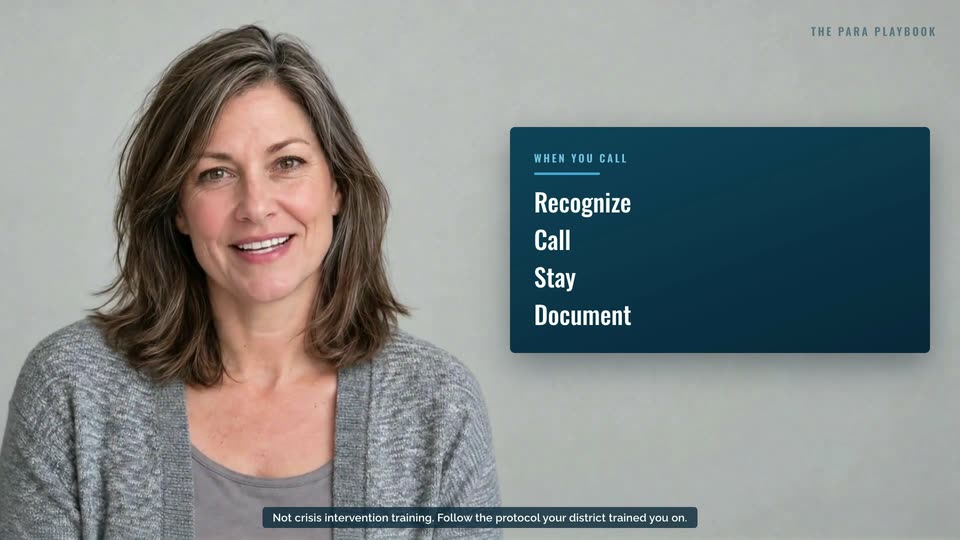
0:00The moment0:13What this is0:24What you get0:33This is not crisis training0:50Escalation is a curve, not a switch1:07Two goals at the peak1:19The behavior is communication1:32Zero to five seconds: your body1:46Five to ten: distance and angle2:04Ten to twenty: move the audience2:18Twenty to thirty: very few words2:38What not to do2:52You are not the last line3:03Recognize, call, stay, document3:16The trap, and it is the recovery3:26The second escalation3:41Recovery is supposed to be boring4:00Write it up the same day4:17Your one thing for tomorrow4:40The deep dive
Get the printable for this lesson
The 30 second sequence.
About 0.5 contact hours of professional learning
- The 4:57 lesson
- Reading the deep dive
- Your district's names and numbers
- The incident write up, practiced on a real one
- Four situations to decide
- Five question self check
- Written commitment
A ParaReady certificate of completion, not an accredited CEU. Districts set their own rules about what counts, so check with yours before planning around these hours.